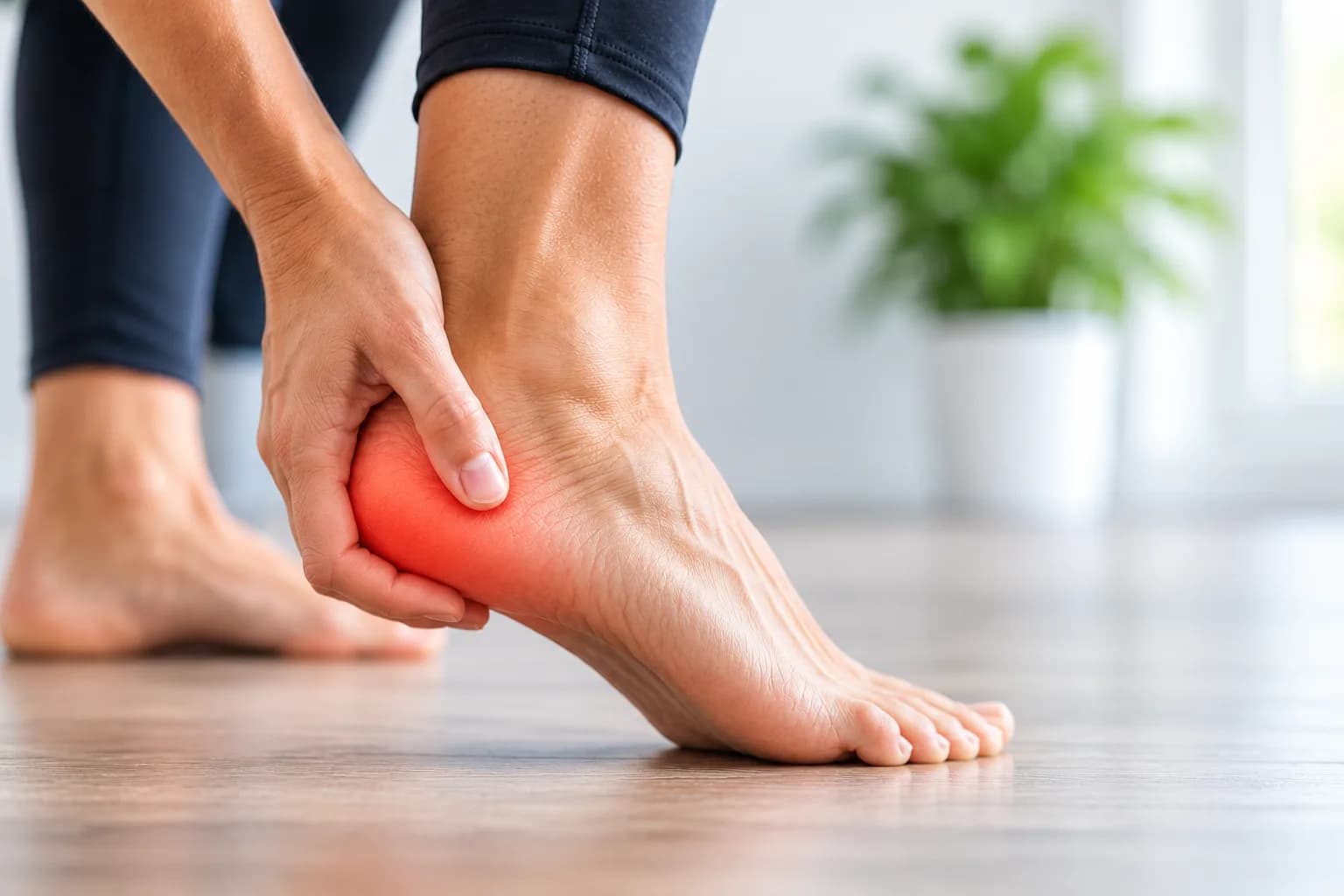
Plantar fasciitis is the most common cause of pain under the heel, and unfortunately the honest answer to "what works best" for treating it is less exciting than what most clinic websites suggest. Plantar fasciitis is usually a load-related, degenerative change where there is chronic breakdown of the tendon's collagen fibers from long-term overuse where the plantar fascia attaches to the heel bone. Because there is not an ongoing inflammatory process, even the term fasciitis is technically incorrect and out of date. The good new is most people improve with a few simple, well-supported measures: education about how to modify load on the plantar fascia, stretching of the calf and plantar fascia, and supportive taping. Shockwave therapy and foot orthoses can also have a role when those first line treatments are not enough. There are several "new" and "exciting" treatments that have been proposed for the treatment of plantar fasciitis that have been shown to actually do very little when researched in a clinical setting.
The typical story is familiar. You wake up in the morning and the first steps out of bed feel like stepping on a stone, then the pain eases after a few minutes of walking and you feel like yourself again. You go about your day only to have the pain returns after a long day on your feet or after sitting for a while. Below, I'll cover how the plantar fascia is built, why it becomes painful, what current guidelines recommend and which treatments are oversold.
Anatomy of the plantar fascia
The plantar fascia is a thick band of connective tissue on the sole of the foot. Strictly speaking it is an aponeurosis: a flat, tendon-like sheet made mostly of collagen fibres running lengthwise. It has a thick central band and thinner medial and lateral bands. The central band, the part involved in plantar fasciitis, arises from the medial tubercle on the underside of the heel bone (calcaneus), fans forward and divides into five slips that blend into the tissues at the base of each toe.
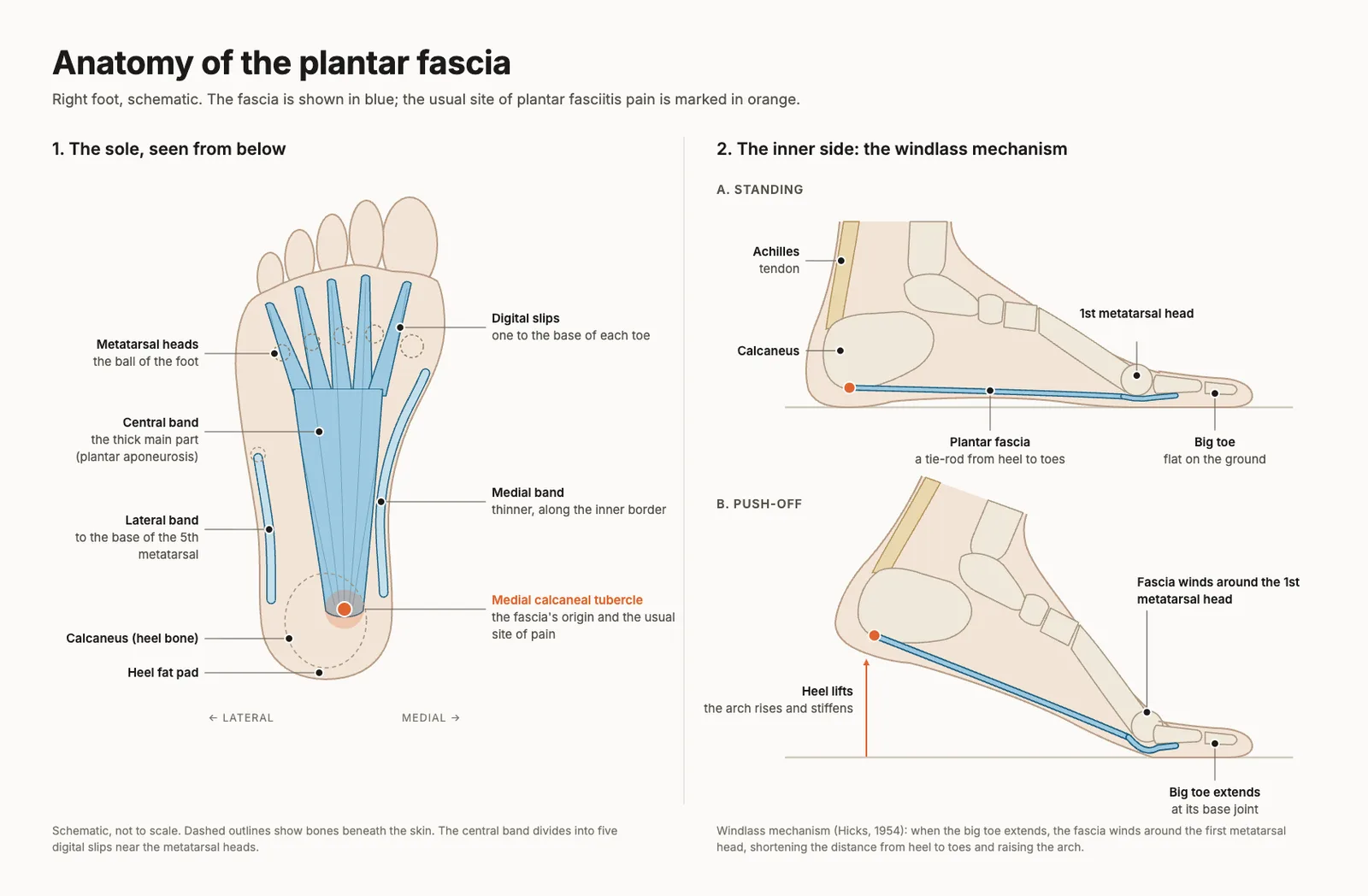
Its main job is to act as a tie-rod for the arch. When you stand, the arch flattens slightly and the fascia is pulled taut, like the string of a bow. During the push-off phase of gait, the toes bend upward and the fascia winds around the metatarsal heads, drawing the heel and forefoot together and raising the arch. This is the windlass mechanism, described by the anatomist J.H. Hicks in 1954, and it turns the foot into a stiffer lever for propulsion. Every step loads the fascia, and its heel attachment absorbs much of that tension.
That attachment to the medial tubercle is where most of the trouble starts. Like a tendon insertion, it is a fibrocartilaginous enthesis: a transition zone between soft tissue and bone that is built to spread stress but can be overwhelmed by it.
Why the plantar fascia becomes painful
Despite the name, plantar fasciitis is usually not an inflammatory condition, which is why many researchers prefer "plantar fasciopathy." When Lemont and colleagues examined tissue from 50 people who had surgery for chronic heel pain, they found myxoid degeneration (normal collagen structure replaced by softer, gel-like material), fragmented fascia and changes in the underlying bone marrow, but no inflammatory cells. That picture closely resembles tendinopathy. The caveat is that surgical specimens come from the most stubborn cases, so early inflammation cannot be fully ruled out, so current physical therapy guidelines describe a spectrum with both inflammatory and degenerative features.
The working clinical model is a mismatch between load and capacity. Repeated tension through the windlass, combined with compression of the heel at each foot strike, concentrates stress at the enthesis (attachement). When load rises faster than the tissue can adapt, collagen repair falls behind, the fascia thickens and becomes disorganized, and the sensitized attachment starts to hurt. First-step pain fits this model: after a night with the foot relaxed and pointed, the first loaded steps suddenly puts tension a stiff, irritable attachment site and you feel that oh-so-familiar stabbing heel pain.
The risk factors of plantar fasciitis also line up with a load problem. A 2016 meta-analysis found that a BMI above 27 was associated with about 3.7 times the odds of plantar fasciopathy, with the strongest effect in non-athletes. Guidelines also list limited ankle dorsiflexion, running and prolonged weight-bearing at work, especially on hard surfaces. Heel spurs deserve a mention. They are more common in people with heel pain, but they also become common with age in people without it, and many researchers now regard them as a marker of long-term loading at the attachment rather than the direct cause of the pain.
How plantar fasciitis is diagnosed, and how long it lasts
Plantar fasciitis is a clinical diagnosis. The classic picture is pain on the underside of the heel slightly to the inside, tenderness over the medial calcaneal tubercle, and pain that is worst with the first steps in the morning or after sitting. Imaging is usually unnecessary when the story fits. When it is used, an ultrasound showing a fascia thicker than about 4 mm supports the diagnosis.
Part of a good assessment is ruling out look-alikes: irritation of the heel fat pad, nerve entrapment, a calcaneal stress fracture and, less often, inflammatory arthritis. Burning, numbness, night pain or pain that does not change with load all point away from a straightforward fasciopathy.
The common claim that most cases settle within a year is unfortunately overly optimistic. In a Danish follow-up of 174 patients from a hospital clinic, about half still had some symptoms five years after onset, and 44% did at 15 years. Women and people with pain in both heels fared worse. That group was harder to treat than average and the definition of "still symptomatic" was strict, but the message holds: this condition can be persistent, which is why a structured plan beats waiting it out.
Plantar fasciitis treatment: what the guidelines recommend
Two documents are most useful here: the American Physical Therapy Association's (APTA) 2023 clinical practice guideline and a 2021 best-practice guide in the British Journal of Sports Medicine (BJSM) that combined a systematic review with expert consensus and patient input. Both point to a stepped approach.
First line: education, stretching, taping and manual therapy
Each treatment plan should start with individualized education about load: how to adjust walking, running and standing time rather than stopping activity altogether, using footwear that is comfortable with a modest heel-to-toe drop, and body weight reductions where relevant. Pair those with plantar fascia-specific and calf stretching, and with taping for short-term relief of first-step pain in the morning or after prolonged sitting. The APTA guideline gives stretching, taping and manual therapy to the foot and ankle its highest grade, and recommends night splints for one to three months when first-step pain dominates. The BJSM guide suggests giving this core plan four to six weeks before adding more.
Second line: shockwave therapy
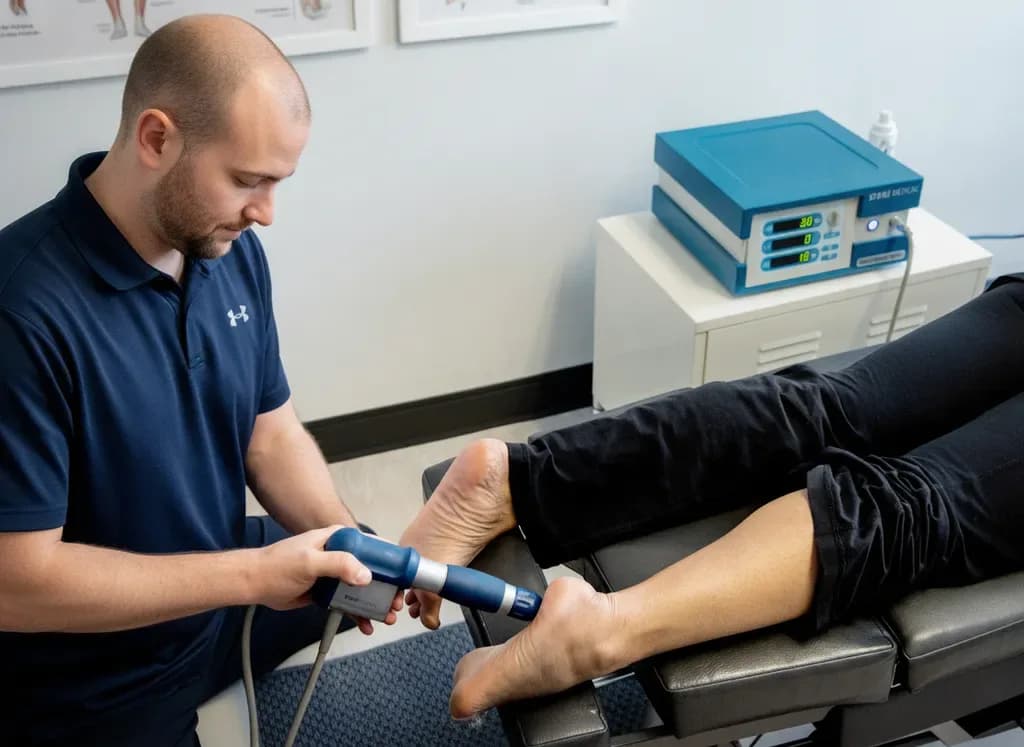
If progress stalls, extracorporeal shockwave therapy (ESWT) is the best-supported next step. In the BJSM review, focused shockwave nearly doubled the odds of improvement in first-step pain in the short term, and radial shockwave showed similar benefits. Some meta-analyses report much larger effects, but a well-designed 2002 sham-controlled trial in JAMA found no benefit. The reasonable reading is that shockwave helps a meaningful share of people with persistent heel pain, is low risk, and works best alongside the core plan rather than instead of it. It is not however a standalone cure all for plantar fasciitis in all people.
Third line: foot orthoses
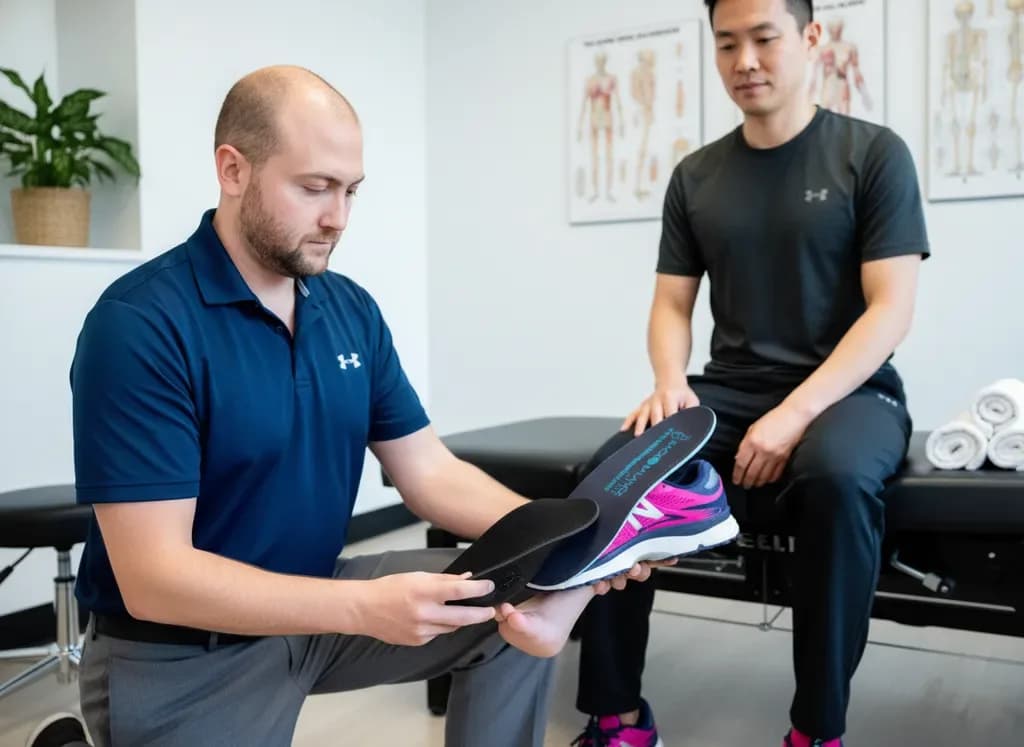
Custom foot orthoses can reduce pain in the short term, but the APTA guideline advises against using them alone, and the BJSM guide places custom orthoses after shockwave. This is because while it may help to improve foot mechanics, poor foot mechanics are not the only thing that can lead to plantar fasciitis. It is important that you get an individualized assessment so your specific cause can be discussed with your practitioner.
Where strength training fits
Heel raises with a towel under the toes became popular after a 2015 trial of 48 people found better function at three months than with stretching, but no difference at 6 or 12 months. A larger 2023 trial of 180 people found that adding heel-raise exercise to advice and a heel cup made no clinically relevant difference. While the results may be mixed, the APTA still recommends resistance training as an adjunct therapy for plantar fasciitis. My take: strength work is sensible for rebuilding capacity, particularly in runners or other patients with high load demands, but it may not be the breakthrough treatment that it was first thought. It doesn't mean that it is useless, but it shouldn't be the only piece of a good treatment plan.
Common treatments that don't work, or are oversold
Some of the most popular options have the weakest support.
Custom orthotics as the first move. In a Dutch trial of 185 people with heel pain, custom insoles were no better than sham insoles at 12 weeks, and people managed by their family doctor with advice and exercises did better on pain and function than the custom-insole group. Prefabricated insoles showed no clear effect in the BJSM review either. Orthoses help some people, but they belong later in the plan and are not a treatment on their own. Custom orthotics are among the most heavily used items in Canadian group benefit plans, which can make coverage look like a recommendation. It isn't one. They may work in some people, but that doesn't mean you should be running to get orthotics as your only method of treatment.
Repeated cortisone injections. A Cochrane review found that steroid injections may slightly reduce heel pain for up to a month, but not beyond. In the 2023 Danish trial, adding an injection produced a difference that was statistically significant but smaller than what patients would notice as meaningful. Cortisone injections also come with some rare but real complications including infection and rupture of the fascia.
Therapeutic ultrasound. The APTA guideline recommends against using it to boost the effect of stretching.
Magnetic insoles and gadgets. Magnetized insoles performed no better than control in the BJSM review, and the same scepticism applies to most heel gadgets sold online.
Platelet-rich plasma (PRP). PRP is widely marketed, but the BJSM guide found no placebo-controlled trials establishing that it works. Treat it as unproven.
Total rest. This point rests on clinical reasoning rather than trials. Backing off aggravating activity during a flare makes sense, but the long natural history suggests that simply waiting for the fascia to heal is a poor strategy, and prolonged inactivity reduces the tissue's tolerance for the load it will eventually need to handle. Some rest early if the fascia is really irritated, or actually inflamed, is reasonable, but this is a discussion with your clinician about your specific circumstance, not using a "I will just rest and wait this out" strategy as a first option.
If you have heel pain that has lasted more than a few weeks or keeps coming back, book an assessment at Back in Balance Clinic. We will confirm whether it is plantar fasciitis, build a plan around the treatments with the best evidence, and add shockwave therapy or custom orthotics if your progress calls for them.
Sources
- Koc TA, et al. Heel Pain – Plantar Fasciitis: Revision 2023. J Orthop Sports Phys Ther, 2023.
- Morrissey D, et al. Management of plantar heel pain: a best practice guide informed by a systematic review, expert clinical reasoning and patient values. Br J Sports Med, 2021.
- Bolgla LA, Malone TR. Plantar fasciitis and the windlass mechanism: a biomechanical link to clinical practice. J Athl Train, 2004.
- Lemont H, et al. Plantar fasciitis: a degenerative process (fasciosis) without inflammation. J Am Podiatr Med Assoc, 2003.
- van Leeuwen KDB, et al. Higher body mass index is associated with plantar fasciopathy/‘plantar fasciitis’. Br J Sports Med, 2016.
- McMillan AM, et al. Diagnostic imaging for chronic plantar heel pain: a systematic review and meta-analysis. J Foot Ankle Res, 2009.
- Hansen L, et al. Long-term prognosis of plantar fasciitis: a 5- to 15-year follow-up study of 174 patients. Orthop J Sports Med, 2018.
- Buchbinder R, et al. Ultrasound-guided extracorporeal shock wave therapy for plantar fasciitis: a randomized controlled trial. JAMA, 2002.
- Rathleff MS, et al. High-load strength training improves outcome in patients with plantar fasciitis. Scand J Med Sci Sports, 2015.
- Riel H, et al. Does a corticosteroid injection plus exercise or exercise alone add to the effect of patient advice and a heel cup for patients with plantar fasciopathy? Br J Sports Med, 2023.
- Rasenberg N, et al. Custom insoles versus sham and GP-led usual care in patients with plantar heel pain: the STAP-study. Br J Sports Med, 2021.
- David JA, et al. Injected corticosteroids for treating plantar heel pain in adults. Cochrane Database Syst Rev, 2017.