If you've just had a concussion, the question you probably care about most is when you can train again. Here's the short answer on return to exercise after concussion:
- Light activity such as walking is usually fine within the first 24 to 48 hours.
- Light aerobic exercise can start soon after, as long as it only mildly and briefly worsens your symptoms.
- Contact and high-intensity training come later, once symptoms have fully resolved (including during and after hard exertion) and a physician or nurse practitioner has cleared you.
One exception: if symptoms are getting worse rather than settling, such as a worsening headache, repeated vomiting, increasing confusion, weakness or a seizure, go to an emergency department.
There are 6 stages to full return to sport, and each stage must be separated by at least 24 hours. This means the fastest that you can get back to sport is about a week, with most athletes taking slightly longer than that, but less than a month.
Why is early return to exercise after concussion recommended?
For years, concussed athletes were told to sit in a dark room until every symptom was gone. That advice has changed in recent years. The 2022 Amsterdam consensus statement, the current international reference on sport-related concussion, found that strict rest is not only not beneficial, it actually makes concussions last longer. It recommends relative rest (normal daily activities, less screen time) for a day or two, then a gradual return to activity.
The best evidence comes from two randomized trials led by John Leddy at the University at Buffalo. Adolescent athletes who started prescribed aerobic exercise within 10 days of injury recovered faster than those assigned to stretching: a median of 13 versus 17 days in the first trial and 14 versus 19 days in the second, which also showed fewer cases of prolonged symptoms.
Two caveats. Both trials enrolled 13- to 18-year-olds, so applying them to adults is reasonable but less directly tested. And the exercise was set below each athlete's measured symptom threshold, which is very different from "push through it."
Why it works is less settled. The leading idea is that controlled aerobic work helps restore autonomic regulation of heart rate and brain blood flow, which concussion disrupts. Plausible, not proven.
How much can symptoms increase during exercise?
Sub-symptom threshold exercise means training just below the intensity where symptoms start to climb. The consensus rule is concrete: symptoms may rise no more than 2 points on a 0–10 scale from where you started, and should settle within an hour.
Say your headache is 2/10 before 20 minutes on a stationary bike. It drifts to 3 or 4, then returns to 2 within half an hour. That's fine. If it climbs to 6, or you still feel worse that evening, stop for the day and repeat the same level tomorrow.
What are the steps of the concussion return-to-sport protocol?
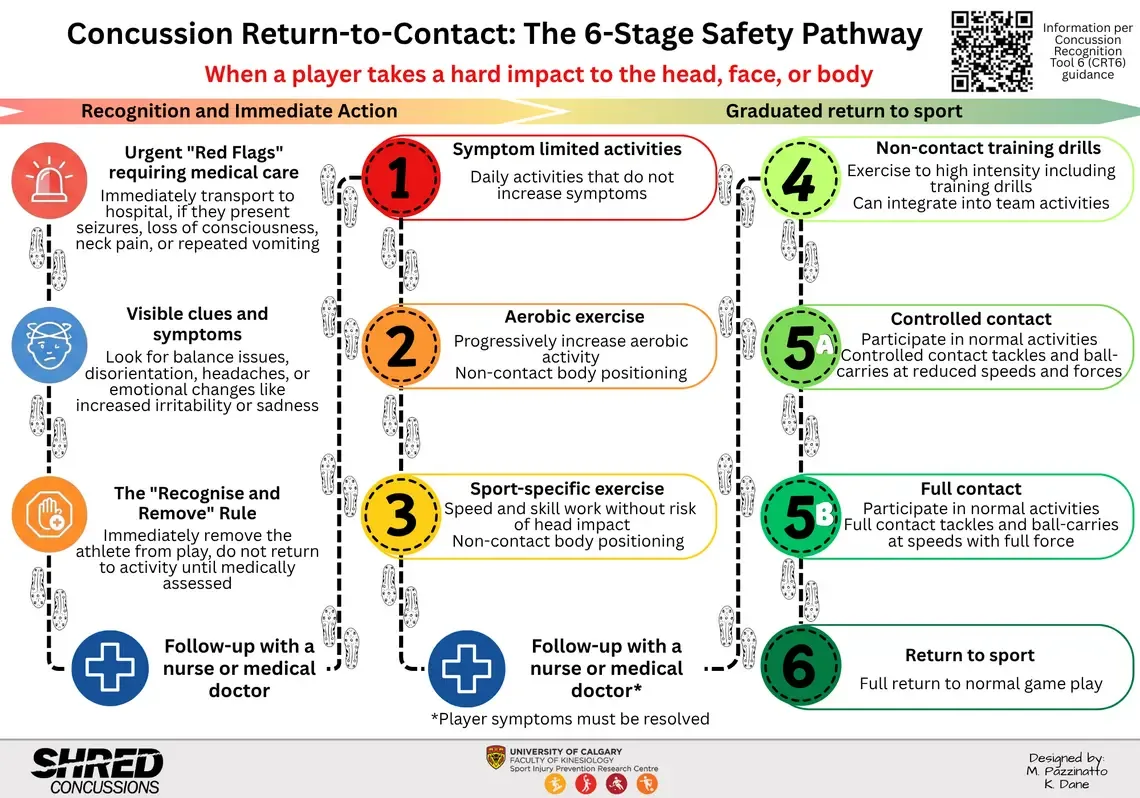
The protocol used in Canada comes from the Amsterdam statement and Parachute's Canadian Guideline on Concussion in Sport (2nd edition, 2024). Each step must be separated by at least 24 hours.
- Daily activity: walking, light chores and social contact for the first 24 to 48 hours.
- Aerobic exercise: light, then moderate. Stationary cycling or brisk walking, up to roughly 55% and then 70% of maximum heart rate. Light resistance training can start.
- Individual sport-specific work: running, changes of direction and solo drills, with no risk of head impact.
- Non-contact training: high-intensity practice and team drills, no body contact.
- Full-contact practice, but no games.
- Unrestricted return to sport.
Steps 1 to 3 are treatment, and mild, brief symptom increases are acceptable. Steps 4 to 6 carry real risk of a hit or fall, so they begin only after full symptom resolution, including with exertion, and medical clearance. Students should be back at school full-time first. If symptoms return after clearance, you drop back to step 3 and need reassessment and clearance again.
A point from the exercise-physiology side: "220 minus age" heart-rate targets are too general to be overly useful, because predicted maximums are often off by 10 beats per minute or more. A graded exertion test that finds your actual symptom threshold gives a far more useful target. Clinically, this is usually done with a Buffalo Concussion Treadmill Test (BCTT), and it is something that you should ask your provider to conduct during the treatment of your concussion to get a more objective look at your activity tolerance.
Who can clear you to return to sport in Ontario?
In Ontario, Rowan's Law names physicians and nurse practitioners as the only health professionals who can medically assess a suspected concussion and confirm clearance to return to amateur competitive sport. Schools follow parallel rules. Under the 2024 Canadian Guideline, clearance now comes before step 4, earlier than it used to.
A chiropractor or physiotherapist can't sign that clearance. A provider trained in concussion management can do most of the work that informs it: a structured office assessment (symptom scales, neck exam, balance, eye-movement and vestibular screening, heart rate and blood pressure lying and standing), exertion testing, supervised progression through steps 1 to 3, and targeted rehab. The physician or NP then decides in conjunction with the results from your treating healthcare provider about whether or not it is safe to return, not just an athlete saying "I feel fine."
For athletes in Toronto and across Ontario, the usual pathway is diagnosis by a physician or NP, assessment and rehab with a trained concussion provider, then clearance from the physician or NP.
Why isn't being symptom-free enough?
The Amsterdam statement defines return to sport as finishing the protocol with no symptoms or clinical findings at rest and with maximal exertion. Plenty of athletes feel normal in a waiting room and still get a headache once their heart rate passes 170. High-intensity sports with cutting and jumping, along with contact sports, also increase the amount of stress the brain must be able to tolerate before safely returning. It is great that you feel better at rest- but that does not mean it is safe for you to return.
The brain may also recover more slowly than the symptoms. Systematic reviews of imaging, blood flow and blood biomarkers suggest physiological changes can outlast clinical recovery, though whether those changes matter is unknown. And a meta-analysis found athletes had about twice the odds of a musculoskeletal injury after returning from concussion. That's observational, so it shows association rather than cause, but it argues against treating clearance as the finish line.
What is the Gapski-Goodman Test, and who needs it?
The Gapski-Goodman Test (GGT) is a standardized, high-intensity exertion test developed by the Chicago Blackhawks' medical staff. It combines aerobic and anaerobic bike intervals with plyometric, sport-like movements and visual and balance challenges, and the athlete must stay symptom-free throughout. A modified version exists for younger athletes and lower-demand sports.
In the main study, 759 athletes aged 13 to 25 took the test after becoming symptom-free and completing the standard return-to-play steps. Even so, 14.6% had symptoms provoked by the test.
That's a useful signal with real limits. It's one cohort, run within the clinic network that adopted the test, with no follow-up on whether athletes who failed did worse. Failure was linked to pre-injury anxiety, so some failures may reflect something other than an unhealed concussion, and fitness can confound any maximal test. Neither the Amsterdam statement nor the Canadian Guideline names the GGT.
My view: for athletes returning to collision or high-speed sports like hockey, football, rugby, lacrosse or soccer, it's a sensible way to check the "no symptoms with maximal exertion" standard before contact. A pass is reassuring. A fail isn't a verdict, just a reason to look closer before clearance.
What if recovery stalls?
If symptoms aren't steadily improving by two to four weeks, a broader assessment is warranted. After four weeks, we say that your symptoms are persistent, and you may be diagnosed with post-concussion syndrome (PCS). For dizziness, neck pain or headaches lasting more than 10 days, the consensus recommends cervicovestibular rehabilitation, targeted treatment of the neck and balance systems. The supporting trials are small but consistent.
In conclusion
If you've had a concussion and want a structured path back to your sport, book a concussion assessment at Back in Balance Clinic. We'll assess where you are, guide your progression and send the results to the physician or nurse practitioner who provides your final clearance.